Thursday, December 7, 2017

  This Year Chanukah begins on December 12, 2017 after nightfall and ends after nighfall of December 20, 2017


A Very Very Simple Guide for Chanukah Celebration


Image result for chanukah pictures


(This Document contains G-d's Name, therefore it may NOT be thrown out)


The Hebrew word Chanukah means "dedication." In the 2nd century BCE, during the time of the Second Holy Temple, the Syrian-Greek regime of Antiochus sought to pull Jews away from Judaism, with the hopes of assimilating them into Greek culture. Antiochus outlawed Jewish observance ― including circumcision, Shabbat, and Torah study ― under penalty of death. As well, many Jews ― called Hellenists ― began to assimilate into Greek culture, taking on Greek names and marrying non-Jews. This began to decay the foundation of Jewish life and practice.
When the Greeks challenged the Jews to sacrifice a pig to a Greek god, a few courageous Jews took to the hills of Judea in open revolt against this threat to Jewish life. Led by Matitiyahu, and later his son Judah the Maccabee, this small band of pious Jews led guerrilla warfare against the Syrian-Greek army. Antiochus sent thousands of well-armed troops to crush the rebellion, but after three years the Maccabees beat incredible odds and miraculously succeeded in driving the foreigners from their land. The victory was on the scale of Israel defeating the combined super-powers of today.


Jewish fighters entered Jerusalem and found the Holy Temple in shambles and desecrated with idols. The Maccabees cleansed the Temple and re-dedicated it on the 25th of Kislev. When it came time to re-light the Menorah, they searched the entire Temple, but found only one jar of pure oil bearing the seal of the High Priest. The group of believers lit the Menorah anyway and were rewarded with a miracle: That small jar of oil burned for eight days, until a new supply of oil could be brought.

From then on, Jews have observed a holiday for eight days, in honor of this historic victory and the miracle of the oil. We celebrate Chanukah by kindling the Menorah for eight days, adding a new light each night. Adding a candle encourages us to grow spiritually and to continuously add holiness to our lives. This is the essence of our faith and it is symbolized by the manner in which we light our Menorahs.


Lighting of the Candles


Both men and women are obligated to light the Chanukah menorah, or to participate in the household menorah lighting. Many have the custom to place the menorah on a windowsill.


On Tuesday evening, December 12, 2017 after the nightfall 5:46 pm NY time -   we kindle the 1st light of Chanukah.

 Image result for chanukah pictures


How to Light


On the first night, place one candle at the far right, as you face the menorah. This applies whether the menorah is placed next to a doorway or by a window. Another candle is placed for the Shamash (taller helper candle) which is used to light the others. It is not counted as one of the candles. First light the Shamash, then recite the blessings, and then use the Shamash to light the Chanukah candle.

On the second night, place two candles in the two far-right positions ― and use the Shamash to light the left one first. The third night, place three candles in the three far-right positions ― and use the Shamash to light them in order, from left to right. Follow this same procedure each night of Chanukah... until all the lights are kindled and glowing brightly! Remember as you gaze upon this spiritual light, it's not only the light of the Menorah, but the eternal Jewish light in our souls.

Image result for chanukah lighting instruction


Blessings to Say


On the first night of Chanukah (Tuesday, December 12 after 5:46 pm) , recite all three blessings. On all subsequent nights, recite blessings number 1 and 2.


1. Ba-ruch A-tah Ado-nai Eh-lo-hei-noo Meh-lech Ha-olam A-sher Ki-deh-sha-noo Beh-mitz-vo-tav Veh-tzi-va-noo Leh-had-lik Ner Cha-noo-kah. Blessed are You, L‑rd our G‑d, King of the universe, who has sanctified us with His commandments, and commanded us to kindle the Chanukah light. 


2. Ba-ruch A-tah Ado-nai Eh-lo-hei-nu Meh-lech Ha-olam Sheh-a-sa Nee-sim La-avo-tei-noo Ba-ya-mim Ha-hem Bee-z’man Ha-zeh. Blessed are You, L‑rd our G‑d, King of the universe, who performed miracles for our forefathers in those days, at this time.


3. Ba-ruch A-tah Ado-nai Eh-lo-hei-noo Me-lech Ha-olam Sheh-heh-cheh-ya-noo Veh-kee-yeh-ma-noo Veh-hee-gee-a-noo Liz-man Ha-zeh. Blessed are You, L‑rd our G‑d, King of the universe, who has granted us life, sustained us, and enabled us to reach this occasion.


For the first half hour when the candles are burning, it is customary to sit by the candles and tell stories relating to the holiday. Work should not be done in the proximity of the burning candles. Women have a custom to refrain from household work during the half hour that the lights are burning, to honor the brave Jewish women who played a significant role in the Chanukah story.


*IMPORTANT: It is forbidden to light a fire on Shabbat, which extends from sunset on Friday evening until nightfall on Saturday night. Therefore, on Friday evening, December 15, the Chanukah lights should be kindled early, before the Shabbat lights, which are lit 18 minutes before sundown, before 4:17 Philadelphia time. Additional oil or larger candles should be used for the Chanukah lights, to make sure they will last a full half hour after nightfall—the standard 30-minute Chanukah candles cannot be used on Friday. From the time the Shabbat candles are lit (Friday evening) until Shabbat ends (after nightfall Saturday night) and until the havdalah prayer (separating Shabbat from the weekday) is recited, the Chanukah menorah should not be relit, moved or prepared. Chanukah lights for Saturday night are kindled only after Shabbat ends after nightfall, after 5:47 Philadelphia time.


Traditions

Chanukah Gelt (money).

It is customary to increase one’s daily giving to charity.

Image result for chanukah gelt

It is traditional to give children Chanukah gelt (money).
Of course, this beautiful custom adds to the children’s happiness and festive spirit. In addition, it gives adults an opportunity to give the children positive reinforcement for exemplary behavior. The children should be encouraged to give charity from a portion of their money.


Playing Dreidel (spinning the Chanukah top)

The widespread custom that children have of playing dreidel also reflects the theme of Chanukah. Because the children have the "Chanukah gelt" that they receive from their parents. The dreidels are inscribed with the Hebrew letters nun, gimel, heh, and peh, the initial letters of the words nes gadol hayah poh – "a great miracle occurred here." Outside the Land of Israel, it is customary to replace the peh with a shin, the initial letter of the word sham – "there," in Eretz Yisrael. Thus, even when the children are playing, the remembrance of the miracle of Chanukah is woven into their games.
Image result for dreidle


Foods Cooked in Oil

Because of the great significance of oil in the story of Chanukah, it is traditional to serve foods cooked in oil. Among the most popular Chanukah dishes are potato latkes (pancakes) and sufganiot (doughnuts).


Image result for latkes


Traditional Chanukah Potato Latkes

You'll need onion, oil, salt, potatoes, eggs, flour and oil. While the recipe works with any type of potato, using Yukon Gold will be much more aesthetically pleasing because they discolor much more slowly than other potatoes and will keep your mixture looking bright and fresh for longer. They also have a buttery taste which will take your latkes to the next level. Most latke recipes call for raw onion, but I like to fry them off first to give the latkes more flavor. Dice the onion and sauté it in 2 tbsp. oil and 1 tsp. salt until golden. Peel and grate the potatoes (by hand or with a food processor) and immediately put the potato shreds into a bowl of cold water. Continue shredding until all the potatoes are grated. Place the eggs, flour, fried onion and 2 tsp. salt in a separate bowl. Drain the grated potato well, add it to the rest of the ingredients and mix immediately. Heat 2-4 tbsp. of oil in a frying pan, over medium heat. Test the oil by dropping a tiny bit of the mixture into the pan. When the oil sizzles upon contact, it is ready. For uniform latkes, use a 1/4 or 1/8 cup measuring cup. Scoop the batter and gently drop it into the oil. Press down gently with the back of the measuring cup to flatten. Fry 2-3 minutes until golden, then flip the latkes and fry 1-2 minutes on the second side. Repeat until all the mixture has been fried. (You will need to add more oil to the pan every couple of batches.)

Ingredients:

  • ½ an onion
  • 2 tbsp. oil
  • 3 tsp. kosher salt, divided
  • 1.5 lbs. Yukon Gold potatoes
  • 2 eggs
  • ¼ cup flour
  • Oil for frying

Directions:

1.     Dice the onion and sauté it in 2 tbsp. oil and 1 tsp. salt until golden.

2.     Grate the potatoes (by hand or in a food processor). Immediately transfer the grated potato to a bowl of cold water.

3.     Place the eggs, flour, fried onion and 2 tsp. salt in a separate bowl. Drain the grated potato well, add it to the rest of the ingredients and mix immediately.

4.     Heat 2-4 tbsp. of oil in a frying pan, over medium heat. Test the oil by dropping a tiny bit of the mixture into the pan. When the oil sizzles upon contact, it is ready.

5.     For uniform latkes, use a 1/4 or 1/8 cup measuring cup. Scoop the batter and gently drop it into the oil. Press down gently with the back of the measuring cup to flatten. Fry 2-3 minutes until golden, then flip the latkes and fry 1-2 minutes on the second side. Repeat until all the mixture has been fried. (You will need to add more oil to the pan every couple of batches.)

Yields: 16 latkes


I know some people are staunch apple sauce and sour cream latke-eaters, but I've never really been able to wrap my mind (or taste-buds) around either of those. I prefer my latkes straight up. What's your latke condiment of choice?


Inspirational Story


 Private Stephen Winneger was on patrol one night during WWII when he saw a figure running through a field. He shouted, "Halt or I'll shoot." The figure ducked behind a tree and started to dig. Stephen again shouted, "Halt or I'll shoot!"  He didn't halt. Stephen caught up with him and tackled him to the ground. To his surprise, he found he had captured a young boy. An ornate Menorah had fallen from the boy's hands in the scuffle and Stephen picked it up. The boy tried desparately to grab it back shouting in Yiddish, "Give it to me! It's mine!" Stephen assured the boy that he was among friends, and that, furthermore, he himself was Jewish.
 
        The boy had just survived several long, tortuous years of the Holocaust in a concentration camp and was naturally mistrustful of all men in uniforms. He had come back to retrieve the menorah he had hidden there. It was all he had left in the world. He had been forced to watch the shooting of his father, and had no idea what had become of his mother.

        Stephen took the boy, whose name was David, under his wing. As they became closer and closer, Stephen's heart went out to the boy. He offered David the opportunity to come back to New York City with him. He accepted and underwent official adoption procedures.

        Back home, a curator of the Jewish Museum in Manhattan, saw the menorah and told David it was a very valuable, historic, European Menorah and that it should be shared with the entire Jewish Community. He offered David $2,500 for the menorah—a staggering sum of money in the late 1940’s!  But David refused the incredible offer, emphatically stating that the menorah had been in his family for over 200 years and that no amount of money could ever make him sell it. He would not part with a family mitzvah tradition.

        When Hanukkah came, David and Stephen lit the menorah in the window of their home in New York City. An hour later there was a knock on the door. When Stephen went to answer he found a woman with a strong German accent who said that she was walking down the street when she saw the menorah in the window. She said that she had once had one just like it in her family and had never seen any other like it. Could she possibly come inside and take a closer look?

        Winneger invited her in and said that the menorah belonged to his son, David, who could perhaps tell her more about it. He went upstairs and called David down to talk to the woman. And that is how David was reunited with his mother.When the Greeks decreed that mitzvos may not be observed, the Jews would not stand for that. They rose up in arms, despite being hopelessly outnumbered. Hashem (G-d) performed a miracle and delivered victory into their hands. When our ancestors found only enough oil for one day, though they needed eight days worth, they did not give up, they still used the oil. Hashem performed a miracle and the oil lasted for eight days. When people extend themselves to do the right thing, amazing things happen, as the following true story illustrates:
 
        Private Stephen Winneger was on patrol one night during WWII when he saw a figure running through a field. He shouted, "Halt or I'll shoot." The figure ducked behind a tree and started to dig. Stephen again shouted, "Halt or I'll shoot!"  He didn't halt. Stephen caught up with him and tackled him to the ground. To his surprise, he found he had captured a young boy. An ornate Menorah had fallen from the boy's hands in the scuffle and Stephen picked it up. The boy tried desperately to grab it back shouting in Yiddish, "Give it to me! It's mine!" Stephen assured the boy that he was among friends, and that, furthermore, he himself was Jewish.
 
        The boy had just survived several long, tortuous years of the Holocaust in a concentration camp and was naturally mistrustful of all men in uniforms. He had come back to retrieve the menorah he had hidden there. It was all he had left in the world. He had been forced to watch the shooting of his father, and had no idea what had become of his mother.

        Stephen took the boy, whose name was David, under his wing. As they became closer and closer, Stephen's heart went out to the boy. He offered David the opportunity to come back to New York City with him. He accepted and underwent official adoption procedures.

        Back home, a curator of the Jewish Museum in Manhattan, saw the menorah and told David it was a very valuable, historic, European Menorah and that it should be shared with the entire Jewish Community. He offered David $2,500 for the menorah—a staggering sum of money in the late 1940’s!  But David refused the incredible offer, emphatically stating that the menorah had been in his family for over 200 years and that no amount of money could ever make him sell it. He would not part with a family mitzvah tradition.

        When Hanukkah came, David and Stephen lit the menorah in the window of their home in New York City. An hour later there was a knock on the door. When Stephen went to answer he found a woman with a strong German accent who said that she was walking down the street when she saw the menorah in the window. She said that she had once had one just like it in her family and had never seen any other like it. Could she possibly come inside and take a closer look?

        Winneger invited her in and said that the menorah belonged to his son, David, who could perhaps tell her more about it. He went upstairs and called David down to talk to the woman. And that is how David was reunited with his mother. (©2016. Printed with permission from Rabbi Baruch Lederman, author of Shulweek www.kehillastorah.org.) 

For more information visit on a holiday visit: http://www.partnersintorah.org/wp-content/uploads/chanukah60.pdf

Monday, November 6, 2017

Close Call: Sometimes Milliseconds Matter

It was a sunny December day in Woodmere, New York, where we lived at the time. Little did I know how close we were to disaster.
Our son woke from his afternoon nap later than usual, so we had to rush out of the house to make it to the fun activity, called Chanukah Wonderland.
They had rented out an entire storefront and the place was packed, with a line forming down the street. We parked and waited quite some time to enter with our impatient two-year-old. The wait felt like an eternity.
Our turn was finally next. When we reached the entrance desk, the woman excused herself to use the restroom. “I’ll just be a minute,” she explained apologetically. After she returned, I fumbled to find our checkbook in my huge diaper bag. At the very bottom was my checkbook, drenched in liquid from my son’s sippy cup. Unbeknownst to me, his milk had been leaking through the bag and had even soiled my skirt!
We quickly paid cash and then I calmly paused, took off the bag, and did a quick wipe down. After everything was clean, we could finally enter.
My husband held our son in his arms and began walking towards the moon bounce that our toddler was pointing to excitedly. As they walked ahead, something caused me to stop. Unexplainably, my feet planted, and I couldn’t bring myself to move. When my husband realized I wasn’t with him, he hesitated, turned around, and took a few steps to walk back to me.
At that moment, in the exact spot my husband had been standing with our son, a huge SUV came bursting through the glass wall of the storefront and continued driving into the Chanukah Wonderland. The car sped right past my husband’s arm, knocking everything down in its path.
The place looked like a bomb scene. People ran out of the car’s way and in milliseconds, the room emptied. After making sure my son and I were out okay, my husband went back in to pick up a toddler that was being trampled on by adults and brought her outside to safety.
We were sure it was a terrorist’s attack, targeting Chabad. After all, it happened just weeks after the Chabad of Mumbai incident.
But it wasn’t an attack; it was an accident caused by a 76-year-old man. The carpet in his car got twisted between the pedals as he was frantically trying to push on his brakes. The more he pressed down on the brake, the harder the rug pushed on the accelerator.
Miraculously, no one died from the incident. A friend of mine was sitting in a seat rocking her baby in the stroller to her right. She picked up the baby to nurse and moments later the car drove into the stroller, causing it to fly in the air. She too missed the car’s wrath by less than two feet.
One man was run over by the car and it took the strength of 12 people to lift it off him. He was injured but eventually recovered.
Chanukah was certainly filled with miracles that year.
I often think of all the small inconveniences of that day that ended up saving our lives. Our son slept later than usual, and we waited an extraordinary amount of time in line. The woman who happened to need to use the restroom. And milk spilt on my leg. Had we already been inside even moments before, we could have been injured, or worse. All these moments of delay that we were initially annoyed about ended up saving us.
I think about this story when I encounter inconvenient delays – the detour, the missed flight, the long wait in line – and tell myself “I am precisely where I am supposed to be at this moment.”
A similar story happened to my grandfather during WWII. He was fighting for the American Army on the ground in France. They reached a house with a white picket fence and marigolds all around. The house looked serene and seemed to be a perfect place to hide for safety. Little did they know it was a decoy and it hid land mines laced with bombs throughout the property. My grandfather experienced a premonition of danger and did not want to open the picket fence. Despite his commander’s orders, he simply refused to obey. His refusal saved his life.
The bomb went off the moment the door was opened. I am here today, along with my children and hundreds of cousins, aunts, and uncles because of his premonition.
We may not always see how, but even the seemingly inconvenient occurrences or inexplicable premonitions are part of a larger plan.
A version of this article appeared in The Jewish Home
This article is one of many that appears in Sarah Pachter’s book Small Choices, Big Changes published by Targum Press. The book has timeless teachings through the lens of Torah consisting of over 60 chapters covering universal topics such as happiness, success, relationships and parenting. 
By Sara Pachter

Thursday, October 26, 2017

The Power of Words

Jerusalem was in an uproar! A well-known man, a member of the Belzer Chasidic sect, and his wife had just given birth to their first child - a boy - after being childless for twenty-eight years!

Well over a thousand people came by to wish Mazel Tov to the proud and exhausted father. The food supply ran out in short order as did the drinks, but no one seemed to mind. At the height of the celebration, the crowd quieted down as the father indicated that he would like to say a few words. He began in a loud voice, "Thank you all for coming and sharing in the joyous celebration. Although I have no more food to offer, let me at least tell over a story which I'm sure you'll appreciate."

The ecstatic new father composed himself and continued. "When I was still an unmarried student learning in the Yeshiva (Rabbinical School), there was a cleaning lady who would come by every day to tidy up and scrub the study hall and adjoining rooms. She was a fixture in the yeshiva and devoted her life to maintaining the building. She was, however, not a wealthy person by any stretch and as her own family grew she was at a loss of options as far as taking care of her children. She decided to bring her kids with her to work, and as she cleaned and mopped in one area of the building, the young children would run amuck, screaming, crying and generally causing quite a commotion, in the rest of the yeshiva. At first, we put up with it; we even thought it was cute for a time. But after a while, the kids really began to disrupt us in our learning. Try as we might to control them, they wouldn't listen and continued on in their childish games and noise. A number of younger students asked me, as one of the oldest in the group to ask her not to bring her children anymore to the school. 

"I agreed to talk to her and I brazenly walked up to her and told her that her kids were disturbing everyone and she should find some sort of alternative method of child-care for them. I'll never forget how she looked at me with tired eyes and said, 'Young man , you should never have the pain and anguish that one goes through when raising children.'

The crowd gasped.

"As many of you know," continued the father, "my wife and I have been to countless doctors who've recommended every sort of treatment. We moved abroad for awhile to be near an 'expert' which proved to be fruitless. One last, extreme treatment was offered and after trying that, it too, turned out to be just a fantasy; we felt doomed to a life without the pleasure of raising a family.

"After that last attempt, as we walked back into the apartment that we lived in for the past twenty-eight years, our entire sad situation hit us full force, like a ton of bricks. Together, we broke down crying, trying to figure out why G-d was testing us this way.

"All of a sudden, I remembered the episode with the cleaning lady and the "blessing" she had given me. It occurred to me to try and reach her and ask for forgiveness. But after all these years, who knows where she would be?

"I spent hours on the phone until I came up with an address, which I ran over to immediately. She did not recognize me obviously, but when I told her over the story, a spark flickered in her eyes. I tearfully apologized for my harsh words and she graciously forgave me with her whole heart." 


Beaming from ear to ear, the father announced, “That took place exactly nine months ago!" 
(©2017. Printed with permission from Rabbi Baruch Lederman, author of Shulweek www.kehillastorah.org.)


Friday, October 20, 2017

The Tower of Babel

The Flood was history. The era of robbery, greed, and corruption was washed away by its powerful waves. Peace and tranquillity reigned. The entire world was now united — against the Almighty. The world community decided that in the interest of harmony they would join forces and build a colossal tower to reach to the heavens. Then they would ascend the tower and do battle with G-d Himself. It was an ambitious dream, but they were united and determined.
G-d, however, had other plans. He would not destroy the builders but rather confuse them. He changed their languages so they were not able to communicate. One man would ask for a hammer and receive a nail, a saw, or a blank stare. Enraged, the requestor would then argue with and even strike his fellow builder who was impeding progress. Eventually a small civil war erupted on the construction site. The men dispersed and the construction project was eternally halted. And seventy distinct nations ultimately emerged.

It is puzzling: how does a problem such as lack of communication stop a lofty project of such tremendous scope? Didn’t the French and British jointly finish the Chunnel, the tunnel that connects the two countries, under the English Channel?

A college professor was known give difficult tests yet he had a very lenient policy. If a student missed the exam he could take a make-up test the next day. The make-up, however, was always the same test the professor had given the day prior.

15 minutes before the final exam, of a particularly difficult semester, the professor received a phone call. The four voices crowding the phone booth sounded desperate.

“Professor, we were on our way to take your final and we got a flat tire. Please let us take a make-up exam tomorrow.” “Certainly,” the professor responded.

The next day the four young men walked in feeling quite smug. They had reviewed the entire final with a friend who had taken it the day before. The professor seated the four students in different corners of the room. He placed a single sheet of paper in front of each one and stated crisply.

“Today’s make-up exam entails just one question. I would like you young men, each in his own way, to write down for me…” he looked at the young men and smiled knowingly — “which tire was flat?”

When the goal entails truth and true good for mankind, when the goals are harmonious with the concepts that transcend culture, language, custom, or vogue, then nothing can impede success.

But when selfishness rules and individual glory and gratification is the motivation, then the simplest problem can cause total disunity, contempt, and ultimately failure.

When our common goals are enveloped in common good, then we can unite under the most difficult of circumstances. However, if our motivations are selfish, the slightest impediment will leave our entire project and mission flat. As flat as the tire of Babel. 

(Rabbi Mordechai Kamenetzky http://www.Torah.org)

Monday, October 16, 2017

Border Police

Someone driving an expensive Mercedes came to the border. The border police suspected contraband and asked him to open the baggage compartment. All they found were buckets of soil.
"What’s this?" they asked him.
"I’m building a new home, and the earth I need for building is cheaper in the other country. So I go there and fill up buckets with sand…" They didn’t believe him. It was strange that one would import soil, just to save a few pennies. So they sifted through the earth hoping to find diamonds but they didn’t find anything, and they let him pass. The following day, he drove his Mercedes to the border, once again. The border patrol sifted through the soil, didn’t find anything and let him on his way. This happened every day for months. After a while, they stopped sifting through the earth, because they saw that there was nothing there.
One day, he came to the border and told the guards that he wouldn’t be coming anymore. "I finished building my house, so there's no reason for me to import anymore earth." They asked him, "Tell us the truth: were you just importing earth all this time? It doesn’t make sense that you would go through all this effort, just because the earth is a few pennies cheaper." He replied, "I'll tell you if you promise that you won’t arrest me and that you won't report me to the government." They promised. He said, "Fools, the soil was just a coy. I was importing Mercedes cars. Every day, I drove a new Mercedes …" 
The moral of the story is that there are lots of things that can distract us from the primary focus of life. Let's not get side-tracked. 

Tuesday, October 3, 2017

This Year Sukkot begins October 4, 2017 at Sunset (6:18 pm NY Time) - Ends on October 13 after Sunset (Shabbat follows the Holiday)

Image result for sukkot pictures

A Very Very Simple Guide for Sukkot Celebration


(In honor of Sukkot, please print BEFORE the Holiday begins - This Document contains G-d's Name, therefore it may NOT be thrown out)


As soon as the solemn day of Yom Kippur is behind us, we focus on the traditions of the upcoming joyous holiday of Sukkot. We build a temporary house called Sukkah, which remind us of the Clouds of Glory with which G-d surrounded the Jewish people in the desert after the Exodus from Egypt.


It is very special to experience a meal in a Sukkah and to 'shake' The Four Species (Lulav, Etrog, Aravot and Hadassim). If you have never done either before, visit http://www.cbscommunitycenter.com.You can also visit www.Chabad.org to find a synagogue near you where you can be accommodated.

Elevating the Mundane - When we do a mitzvah (a commandment), we elevate ourselves, the object with which we did the mitzvah, and our environment. Most commandments are focused only on limited aspects of our being and limited dimensions of our environment. However, when it comes to dwelling in a Sukkah, not only is the entire body enveloped by the mitzvah, but so are the most mundane aspects of life. After all, by eating, drinking or even reading a good book in the Sukkah, we perform a mitzvah that encompasses our entire body!

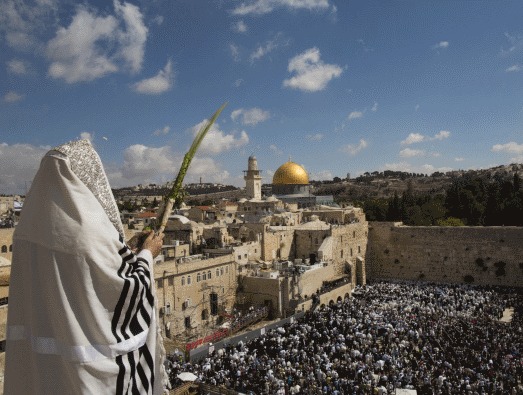
Image result for sukkot pictures jerusalem


CANDLE LIGHING


Women (or if there isn't a woman in the house, the head of the household) lights candles.


Please light from existing fire of a candle you light prior to the Holiday.


On Wednesday October 4th (6:18 pm NY Time) and Thursday October 5 (after 7:46 pm NY Time) and


Wednesday October 11th (6:07 pm NY Time)  and Thursday October 12th (after 7:35 pm)  5 say two prayers below:


1. Ba-ruch A-tah Ado-nai E-lo-hei-nu me-lech ha-olam asher ki-deshanu be-mitzvo-tav ve-tzvi-vanu Lehadlik Ner Shel Yom Tov


(Blessed are You, L-rd our G-d, King of the universe, who has sanctified us with His commandments and has commanded us to light the candle of the Holiday.


2 . Ba-ruch A-tah Ado-nai E-lo-hei-nu me-lech ha-olam she-heche-ya-nu ve-ki-yi-ma-nu ve-higi-a-nu liz-man ha-zeh


(Blessed are You, Lord our G-d, King of the universe, who has granted us life, sustained us, and enabled us to reach this occasion.)


On Friday October 6th  (at 6:15 pm NY Time) and Friday October 13th (at 6:04 pm NY Time) say:


Ba-ruch A-tah Ado-nai E-lo-hei-nu me-lech ha-olam asher ki-deshanu be-mitzvo-tav ve-tzvi-vanu Lehadlik Ner Shel Shabbos


(Blessed are You, L-rd our G-d, King of the universe, who has sanctified us with His commandments and has commanded us to  kindle the light of the Holy Shabbat)


Evening Kiddush for Wednesday and Thursday Nights


Kiddush is recited while holding a cup of kosher wine or grape juice.


Barukh atah A-do-nai, Elohaynu, melekh ha-olam asher bachar banu mee-kol am, v'rom'manu mee-kol lashon v'kee'd'shanu b'meetzvotav, va-teeten lanu, A-do-nai Elohaynu, b'ahavah mo'adeem l'seemchah, chageem u-z'maneem l'sason, et yom chag ha-Sukkot hazeh, z'man seemchateinumeekra kodesh, zeicher leetzeeyat meetz'rayeem Ki Vanu Vacharta V’osanu Keedashtsa Mekol Haamim U-mo'aday Kadsh’kha b'simchah u-v'sason hin’chal’tanu. Barukh atah Adonai, m’kadesh Yisra'el v'ha-z'manim. (Amein)

Blessed are you, Lord, our God, king of the universe who has chosen us from among all people, and exalted us above every tongue and sanctified us with His commandments, and you gave us, Lord our God, with love appointed festivals for gladness, festivals and times for joy, this day of the festival of Sukkot, the time of our gladness a holy convocation, a memorial of the exodus from Egypt Indeed, You have chosen us and made us holy among all peoples and your holy festivals in gladness and in joy you have given us for an inheritance Blessed are You, who sanctifies Israel and the seasons. (Amen)


Friday Night Kiddush


Part 1 : (Quietly: Va-ye-hee erev, va-ye-hee voker.) Yom Ha-shishi. Va-ye-chulu hasha-mayim vi-ha-aretz vi-kole tzi-va-am. Va-yichal Elohim ba-yom hashe-vi'i milach-to asher asa. Va-yish-bose ba-yome hashe-vi'I mi-kole milach-to asher asa. Va-ye-varech Elohim es yom hashe-vi'i va-yi-kadesh oso. Kee voe shavas mi-kole milach-toe asher bara Elohim la-a-sose.

(Quietly: It was evening and it was morning.) The sixth day. So the heavens and the earth were finished, with all their complement. On the seventh day, God had completed His work which He had undertaken, and He rested on the seventh day from all His work which He had been doing. Then God blessed the seventh day and made it holy, because on it He ceased from all His creative work, which God had brought into being to fulfill its purpose.

Part 2:  Savri maranan ve-rabanan ve-rabosai: Baruch ata Adonoy, Eloheinu melech ha-olam, borei peri ha-gafen. (Others respond: "Amen")

Blessed are You God, King of the Universe, Creator of the fruit of the vine. (Others respond: "Amen")

Part 3: Baruch ata Adonoy, Elo-heinu melech ha-Olam, asher kidish-anu bi-mitz-vosav vi-ratza vanu, vi-Shabbos kod-sho bi-ahava uv-ratzon hin-chi-lanu, zikaron lima-aseh vi-raishis. Ki hu yom ti-chila li-mikra-ay kodesh, zay-cher li-tzi-as mitz-rayim. Ki vanu vachar-ta vi-osanu kidash-ta mikol ha-amim. Vi-shabbos kod-shicha bi-ahava uv-ratzon hinchal-tanu. Baruch ata Adonoy, mi-kadesh ha-shabbos. ("Amen")

Blessed are You God, King of the Universe, who made us holy with his commandments and favored us, and gave us His holy Shabbat, in love and favor, to be our heritage, as a reminder of the Creation. It is the foremost day of the holy festivals marking the Exodus from Egypt. For out of all the nations You chose us and made us holy, and You gave us Your holy Shabbat, in love and favor, as our heritage. Blessed are you God, Who sanctifies Shabbat. (“Amen”)

Part 4:  Ba-ruch A-tah Ado-nai E-lo-hei-nu Me-lech Ha-olam Asher Kideshanu Bemitzvotav Vetzivanu Leshev Basukkah.

Blessed are You, Lord our G‑d, King of the universe, who has sanctified us with His commandments, and commanded us to sit in the Sukkah.


Before drinking the wine sit down and say the following blessing for the Sukkah:


Baruch atah A-donoy, Elo-heinu Melech Ha’Olam, asher kidshanu bemitzvotav vetzivanu Leishev baSukah


Blessed are you, Lord, our G-d, sovereign king of the universe who sanctified us through His mitzvah of dwelling in the Sukkah


Barukh atah Adonai, Eloheinu, melekh ha'olam shehecheyanu v'kiyimanu v'higi'anu laz'man hazeh.


Blessed are you, Lord, our God, sovereign king of the universe who has kept us alive, sustained us, and enabled us to reach this season (Amen)


Pour some wine into a separate cup for guests and then drink the rest yourself without talking.


Challah in Honey


Immediately following the kiddush, we perform the ritual washing for bread. Fill a large cup with water. Pass the cup to your left hand and pour three times over your right hand. Repeat by pouring on your left hand. As you wipe your hands recite the blessing:


Baruch atah A-donoy, Elo-heinu Melech Ha’Olam, asher kidshanu bemitzvotav vetzivanu al netilat yadayim.


When everyone has returned to the table, we raise the two challah loaves and recite the blessing:


Ba-ruch atah A-do-nay, E-lo-hei-nu Melech Ha-Olam, hamotzie le-chem min ha-are-tz.


Blessed are You, L-rd, our G‑d, King of the universe, who brings forth bread from the earth.


Cut the challah, dip it in honey and salt, and have a bite. Pass around pieces and make sure everyone does the same.


Important Addition for this Year:

Since the Holiday goes straight into Shabbath, in order to cook for Shabbath one must make an Eruv Tavshilin ritual.


What is the procedure for Eruv Tavshilin?

Before the beginning of the Holiday one sets aside two types of food, one cooked and one baked. If one cannot obtain both items, a cooked item alone would be acceptable but a baked item alone would not suffice. The cooked item must be at least the size of a large olive (approximately half the size of a chicken’s egg) and the baked item should be at least the size of a chicken’s egg.

 "With this Eruv it should be permitted for us to bake, cook, insulate food, light a candle, and do any need from Yom Tov for Shabbat".


UNIQUE FEATURES OF SUKKOT


Image result for sukkot pictures


A Sukkah is a hut built to provide shade. That's why it must sit beneath the open sky—not under a patio deck or even the branches of a tree. The walls can be made of any material, as long as they are secure and don't flap about in the wind. The roof, however, (we call it s'chach), must be of unprocessed materials which have grown from the ground. Bamboo poles, thin wooden slats, and evergreen branches are popular choices. We make sure to use enough s'chach so that the inside of the sukkah has more shade than sunlight.


On Sukkot, along with the mitzvah of dwelling in the Sukkah comes the Scriptural obligation of “taking” the Four Species as instructed by the verse, “On the first day, you must take for yourself a fruit of the citron tree, an unopened palm frond, myrtle branches and willows of the brook.”


We take the Four species on all days of Sukkot except Shabbat 


The Four Species are co-dependent, and if one of the four is missing, the mitzvah is not fulfilled. In total, seven individual items are required for the mitzvah:


1. One Lulav


2. One Etrog


3. Two Aravot


4. Three Hadassim


Why are these four plants used instead of other plants? There are two primary explanations of the symbolic significance of these plants: that they represent different parts of the body, or that they represent different kinds of Jews.


According to the first interpretation, the long straight palm branch represents the spine. The myrtle leaf, which is a small oval, represents the eye. The willow leaf, a long oval, represents the mouth, and the Etrog fruit represents the heart.


All of these parts have the potential to be used for sin, but should join together in the performance of commandments and bring Divine Light into the world.


According to the second interpretation, the Etrog, which has both a pleasing taste and a pleasing scent, represents Jews who have achieved both knowledge of Torah and performance of mitzvot (commandments). The palm branch, which produces tasty fruit, but has no scent, represents Jews who have knowledge of Torah but are lacking in mitzvot. The myrtle leaf, which has a strong scent but no taste, represents Jews who perform mitzvot but have little knowledge of Torah. The willow, which has neither taste nor scent, represents Jews who have no knowledge of Torah and do not perform the mitzvot.


We bring all four of these species together on Sukkot to remind us that every one of these four kinds of Jews is important, and that we must all be united.


The Blessing for the Four Species


Take the etrog in your left hand with the stem (green tip) up and the pitam (brown tip) down. Take the lulav (including the palm, myrtle and willow branches bound together) in your right hand. Bring your hands together and recite the blessing below.


Barukh atah A-do-nai, Eloheinu, melekh ha-olam asher kidishanu b'mitz'votav v'tzivanu al n'tilat lulav (Amein)
Blessed are you, Lord, our God, sovereign of the universe Who has sanctified us with His commandments and commanded us to take up the lulav (Amen)

First Day Only Add:

Barukh atah Adonai, Eloheinu, melekh ha'olam
shehecheyanu v'kiyimanu v'higi'anu laz'man hazeh.
Blessed are you, Lord, our God, sovereign king of the universe
who has kept us alive, sustained us, and enabled us to reach this season (Amen)


After you recite the blessing, turn the etrog so the stem is down and the pitam is up. (Be careful not to damage the pitam)

With the lulav and etrog together, gently shake forward (East) three times, then pull the lulav and etrog back in front of your chest. Repeat this to the right (South), then over your right shoulder (West), then to the left (North), then up, then down.


Seven Guests

 Image result for sukkot pictures

Sukkah generates an intense concentration of spiritual energy. During Sukkot the souls of the seven great leaders of Israel –Abraham, Isaac, Jacob, Moses, Aaron, Joseph, and King David – actually leave Heavenly realm to partake in the Divine Light of Sukkot. Collectively these transcendent guests are known as Ushpizin, the Aramaic word meaning "guests."


Each of the seven Ushpizin correspond to a fundamental spiritual pathway through which the world is perfected


·                                 Abraham represents love and kindness

·                                 Isaac represents restraint and personal strength

·                                 Jacob represents beauty and truth

·                                 Moses represents eternality and dominance through Torah

·                                 Aaron represents empathy and receptivity to divine splendor

·                                 Joseph represents holiness and the spiritual foundation

·                                 David represents the establishment of the kingdom of Heaven on Earth


We can connect to these energies and learn from our great leaders.


Simchat Torah

Sukkot is the only holiday that really encompasses two holidays: Seven days of Sukkot and one day of Shemini Atzeret [upon which we celebrate Simchat Torah]. These final two days begin at sundown on October 11 until nightfall on October 13 in 2017.

On this final day, it is customary to conclude and then immediately begin the annual cycle of Torah reading.

The highlight of this holiday is the boisterous singing and dancing in the synagogue, as the Torah scrolls are paraded in circles around.

Although the eighth day follows Sukkot, it is actually an independent holiday in many respects (we no longer take the Four Kinds or dwell in the sukkah). Jews outside of Israel still eat in the sukkah.


The intermediate days (nightfall on October 6 until sundown on October 11 in 2017) are quasi holidays, known as Chol Hamoed


Water and Joy

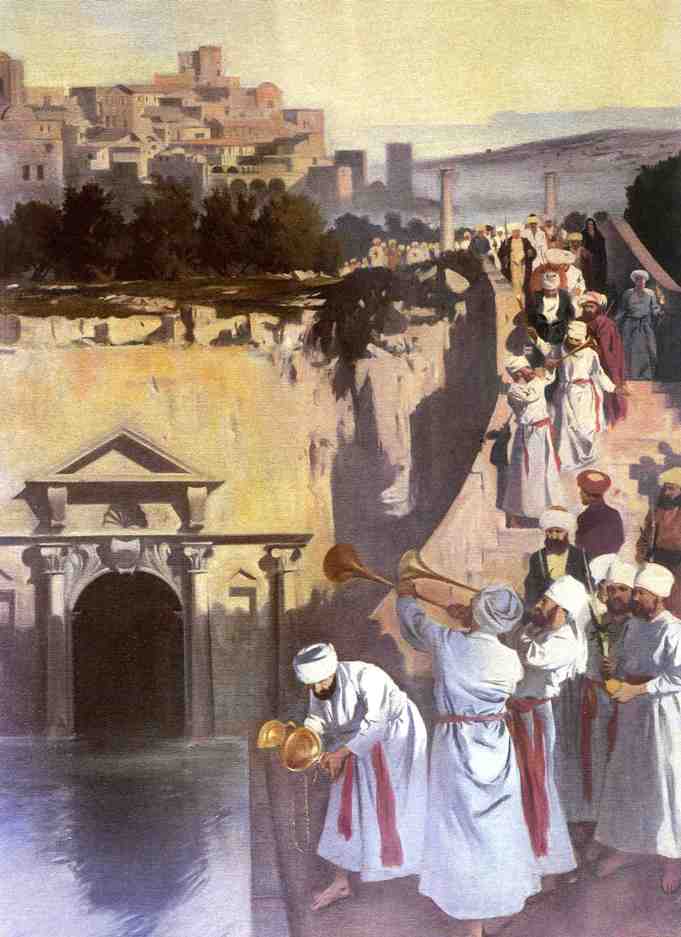
On Sukkot, G‑d determines how much rain will fall that winter (the rainy season in Israel). Thus while every sacrifice in the Temple included wine libations poured over the altar, on Sukkot, water was also poured over the altar in a special ceremony. This ritual engendered such joy that it was celebrated with music, dancing and singing all night long. This celebration was called was “Simchat Beit Hasho’evah.”

Even today, when there is no Temple, it is customary to hold nightly celebrations that include singing and dancing (and even live music during the intermediate days of the holiday).

Image result for sukkot pictures water ceremony


Inspirational Story


As we begin the New Year, we are humbled by the realization how dependant we are on our Creator. As we sit in the Sukkah during the Holiday of Sukkot, we are meant to ponder upon just how fragile our lives really are and how appreciative we must be of getting a gift of another year of Life. As the following true story illustrates.


Had this not happened to me I would never have believed it. I was driving my smart car one day in Borough Park in New York  and for those of you that don’t know, a smart car is small and lightweight car. I stopped at a red light but I was daydreaming and when it became green I did not start driving right away. The driver in the car behind me – let’s call him Mr. Lexus – was very impatient and started honking his horn. As I started driving down the next block Mr. Lexus started to tailgate me and was overall acting in a very aggressive manner. Not wanting to be harassed I pulled over to the side and let Mr. Lexus move in front of me.


As we came to the very next intersection the light was green and the Mr. Lexus rightfully proceeded to enter the intersection. When he was in middle the intersection a tow truck driving at 50 mph ran a red light and T-boned Mr. Lexus. The impact flipped Mr. Lexus’s car and send it tumbling over forty feet. Had I not moved over to let Mr. Lexus pass me, then I would have been in the intersection, and a driver of a smart car does not survive when a tow truck hits it at 50 mph.


All of this started with the little detail of me having a daydream in my car. I guess what I am trying to say is that we sometimes have this idea that G-d is busy with the big issues of the world, the natural disasters, the climate change, and geopolitics. This story showed me that G-d is also involved in our day-to-day lives, and even a small detail like me getting harassed by an aggressive driver, was all part of a plan that was ultimately for my best. I came out of this not only shaken up because I almost lost my life but because I realized how precious and fragile life is. Enjoy every moment!


Image result for sukkot pictures


For my Short Russian video on the Holiday, please visit
http://youtu.be/czN9RjqG2gI


For more information visit

http://www.partnersintorah.org/wp-content/uploads/succosin60.pdf