A Very Very Simple
Guide for Rosh Hashana Celebration
(This Document
contains G-d's Name, therefore it may NOT be thrown out)
1.
Lighting of the
Candles
Women
(or if there isn't a woman in the house, the head of the household), light
candles.
Blessings
for the evenings September 20, 2017 (6.41 pm Philadelphia Time) and September
21, 2017(after 8:09 Philadelphia
Time):
1) Ba-ruch
A-tah Ado-nai E-lo-hei-nu me-lech ha-olam asher ki-deshanu be-mitzvo-tav
ve-tzvi-vanu le-hadlik ner shel Yom Tov Blessed are You, L-rd our G-d,
King of the universe, who has sanctified us with His commandments and has
commanded us to light the candle of the Holiday.
[Note: When reciting the following blessing on the second night of the
holiday, one should have in mind the new fruit which one will subsequently be
eating after Kiddush.]
2) Ba-ruch A-tah Ado-nai E-lo-hei-nu me-lech ha-olam she-heche-ya-nu
ve-ki-yi-ma-nu ve-higi-a-nu liz-man ha-zeh.
Blessed are You, L-ord our G-d, King of the universe, who has granted us
life, sustained us, and enabled us to reach this occasion.
2.
Evening Kiddush for Rosh Hashanah
Kiddush
is recited while holding a cup of kosher wine or grape juice. (Challah should
be on the table - covered)
1st
prayer:
Barukh atah Adonai, Eloheinu, melekh ha'olam
Blessed are you, Lord, our God, sovereign of the universe
borei p'ri hagafen (Amein)
Who creates the fruit of the vine (Amen)
Barukh atah Adonai, Eloheinu, melekh ha'olam
Blessed are you, Lord, our God, sovereign of the universe
asher bachar banu mikol am v'rom'manu mikol lashon
who has chosen us from among all people, and exalted us above every tongue
v'kid'shanu b'mitz'votav vatiten lanu Adonai Eloheinu, b'ahavah
and sanctified us with His commandments,and you gave us, Lord our God, with
love
et yom
with love this day of
hazikaron hazeh yom t'ru'ah
remembrance, a day of shofar blowing
mik'ra kodesh zeikher litzi'at mitz'rayim
a holy convocation, a memorial of the exodus from Egypt
ki vanu vachar'ta v'otanu kidash'ta mikol ha'amim
Indeed, You have chosen us and made us holy from all peoples
ud'var'kha emet v'kayam la'ad
and Your word is true and established for ever
Barukh atah Adonai melekh al kol ha'aretz
Blessed are You, Lord, our God, King over all the world,
m'kadeish yisra'eil v'yom hazikaron. (Amein)
Who sanctifies Israel and the Day of
Remembrance. (Amen)
2nd
prayer:
בָּרוּךְ אַתָּה יְיָ אֱלֹהֵֽינוּ מֶֽלֶךְ
הָעוֹלָם שֶׁהֶחֱיָנוּ וְקִיְּמָנוּ וְהִגִּיעָנוּ לזְּמַן הַזֶּה.
Barukh atah Ad-onai,
El-oheinu, melekh ha'olam shehecheyanu
v'kiyimanu v'higi'anu laz'man hazeh.
Blessed are you, Lord, our God, sovereign of the universe who has kept us
alive, sustained us, and enabled us to reach this season (Amen)
2A
SECOND NIGHT ONLY -New Fruit
On the second night of Rosh Hashanah, a "new fruit," i.e., a
seasonal fruit which we have not yet tasted since its season began, should be
present on the table when the holiday candles are kindled and during the kiddush.
While reciting the Shehecheyanu blessing after candle-lighting and
after the kiddush, one should have the new fruit in mind.
This fruit is eaten following the kiddush, before washing for
bread. Before partaking of the fruit we say the following blessing:
Ba-ruch a-tah Ado-nai E-lo-hei-nu me-lech ha-olam bore pri ha-etz.
Blessed are You, L-rd our G‑d, King of the universe, who creates the fruit
of the tree.
ROUND Challah in Honey
Immediately following the kiddush
(and on the second night, the eating of the new fruit), we perform the ritual
washing for bread. Fill a large cup with water. Pass the cup to your left
hand and pour three times over your right hand. Repeat by pouring on your
left hand. As you wipe your hands recite the blessing:
Baruch atah A-donoy, Elo-heinu Melech
Ha’Olam, asher kidshanu bemitzvotav vetzivanu al netilat yadayim.
Blessed are You, L-rd our G‑d, King of
the universe, who sanctified with His Mitzvahs and commanded us on washing
our hands.
When everyone has returned to the table,
we raise the two challah loaves and recite the blessing:
Ba-ruch atah A-do-nay, E-lo-hei-nu
Melech Ha-Olam, hamotzie le-chem min ha-are-tz.
[Blessed are You, L-rd, our G‑d, King of
the universe, who brings forth bread from the earth.]
Cut the challah, dip it in honey, and
have a bite. Pass around pieces and make sure everyone does the same.
4
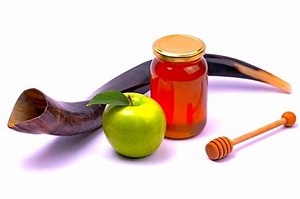
Apples and Honey
During Rosh Hashanah,
it is traditional to eat apples dipped in honey, to symbolize our hopes for a
"sweet" new year. The apple is dipped in honey, the blessing for
eating tree fruits is recited, the apple is tasted, and then the apples and
honey prayer is recited.
Barukh atah Ad-onai, El-oheinu, melekh
ha'olam borei p'ri
ha'eitz.
Blessed are you, L-rd, our G-d, king of the universe who creates the fruit of
the tree. (Everyone says Amen)
Take a bite from the
apple dipped in honey, then continue with the following:
y'hi
ratzon mil'fanekha Adonai el-oheinu vei'-lohei avoteinu sh't'chadeish
aleinu shanah tovah um'tukah
May it be Your will, L-rd our G-d and God of our ancestors that you renew for
us a good and sweet year.
5
Symbolic Foods
A head of a fish is served. We
say “May it be your will Eternal God that we should be at the head and not at the tail”.
A pomegranate is eaten,
symbolizing our wish to have a year full of mitzvot and good deeds. We say
“May it be your will Eternal God that our year is filled with good deeds as a
pomegranate is filled with luscious seeds”.
There is a custom to eat fish
on Rosh Hashana. Fish multiply in great number. They never sleep. They swim
in water. We hope the year will be one of plenty, just as fish are extremely
fruitful. Just as fish never sleep, we hope to maintain a constant awareness
of our mission in life. Since fish are underwater the evil eye cannot
penetrate the depths, and we wish to be free of any negative wishes.
We also eat Leeks or Cabbage. These vegetables are
known as karsi, related to the word karet, to cut off or destroy. As we eat
it we say “May it be your will Eternal God that our enemies will be
destroyed.”.
Beets are known as “silka,”
related to the word “siluk,” meaning removal. The adversaries referred to in
the prayer before eating the beet are the spiritual roadblocks created by the
past year’s missteps that must be removed before a sweet New Year is granted.
We say “May it be your will Eternal God that our adversaries will be
removed.”
Dates are known as “tamri”
is related to the word “tamri,” meaning consume or finish. This food is
similar to the beets and leeks in that it is eaten with the intent that all
enemies will end their detrimental wrath. We say “ May it be your will
Eternal God that our enemies will be finished.
Throughout the meal, it is customary to also eat foods whose names in the
vernacular allude to blessing and prosperity. For example, many have the
custom of eating carrots because in Yiddish the word for carrots, meren,
means to multiply.
6
Rosh Hashanah Cuisine
On Rosh Hashanah it is customary not to eat foods which are sour or tart
(the gefilte fish will have to do without the horseradish...). Instead, the
focus is on sweet foods, symbolizing our desire to have a sweet year,
blessings and abundance. It is also customary not to eat nuts on Rosh
Hashanah, as the numerical value of the Hebrew word for nuts ("egoz")
is the same as the Hebrew word for sin ("chet").
7
Blessing After Meal
Blessed are You,
L-rd our G-d, King of the universe, who, in His goodness, provides sustenance
for the entire world with grace, with kindness, and with mercy. He gives food
to all flesh, for His kindness is everlasting. Through His great goodness to
us continuously we do not lack [food], and may we never lack food, for the
sake of His great Name. For He, benevolent G-d, provides nourishment and
sustenance for all, does good to all, and prepares food for all His creatures
whom He has created, as it is said: You open Your hand and satisfy the desire
of every living thing. Blessed are You, L-rd, who provides food for all.
We offer thanks
to You, L-rd our G-d, for having given as a heritage to our ancestors a
precious, good and spacious land; for having brought us out, L-rd our G-d,
from the land of Egypt, and redeemed us from the house of bondage; for Your
covenant which You have sealed in our flesh; for Your Torah which You have
taught us; for Your statutes which You have made known to us; for the life,
favor, and kindness which You have graciously bestowed upon us; and for the
food we eat with which You constantly nourish and sustain us every day, at
all times, and at every hour.
For all this,
L-rd our G-d, we give thanks to You and bless You. May Your Name be blessed
by the mouth of every living being, constantly and forever, as it is written:
When you have eaten and are satiated, you shall bless the L-rd your G-d for
the good land which He has given you. Blessed are You, L-rd, for the land and
for the sustenance.
Have mercy,
L-rd our G-d, upon Israel
Your people, upon Jerusalem Your city, upon Zion the abode of Your
glory, upon the kingship of the house of David Your anointed, and upon the
great and holy House over which Your Name was proclaimed. Our G-d, our
Father, our Shepherd, nourish us, sustain us, feed us, and provide us with
plenty; and speedily, L-rd our G-d, grant us relief from all our afflictions.
L-rd our G-d, please do not make us dependent upon the gifts of mortal men
nor upon their loans, but only upon Your full, open, holy, and generous hand,
that we may never be shamed or disgraced. As the leader recites aloud the
words Remember…for good life in the following paragraph, the others respond
Amen as indicated.
Our G-d and G-d of our fathers, may there ascend, come, and
reach; be seen, accepted, and heard; recalled and remembered before You the
remembrance and recollection of us, the remembrance of our fathers, the
remembrance of Mashiach the son of David Your servant, the remembrance of
Jerusalem Your holy city, and the remembrance of all Your people the House of
Israel, for deliverance, well-being, grace, kindness, mercy, good life, and
peace, on this day of the festival of Remembrance. Remember us on this [day],
L-rd our G-d, for good (Amen); be mindful of us on this [day] for blessing
(Amen); help us on this [day] for good life (Amen). With the promise of
deliverance and compassion, spare us and be gracious to us, and have mercy
upon us and deliver us, for our eyes are directed to You; for You, G-d, are a
gracious and merciful King. And
rebuild Jerusalem
the holy city speedily in our days. Blessed are You, L-rd, who in His mercy
rebuilds Jerusalem.
Amen.
Blessed are You, L-rd our G-d, King of the universe,
benevolent G-d, our Father, our King, our Strength, our Creator, our
Redeemer, our Maker, our Holy One, the Holy One of Jacob, our Shepherd, the
Shepherd of Israel, the King who is good and does good to all, each and every
day. He has done good for us, He does good for us, and He will do good for
us; He has bestowed, He bestows, and He will forever bestow upon us grace,
kindness, and mercy; relief, salvation and success; blessing and deliverance;
consolation, livelihood and sustenance; compassion, life, peace, and all
goodness; and may He never cause us to lack any good. May the Merciful One
reign over us forever and ever. May the Merciful One be blessed in heaven and
on earth. May the Merciful One be praised for all generations, and pride
Himself in us forever and to all eternity, and glorify Himself in us forever
and ever. May the Merciful One provide our livelihood with honor.
May the Merciful One break the yoke of exile from our neck,
and may He lead us upright to our land. May the Merciful One send abundant
blessing into this house and upon this table at which we have eaten. May the
Merciful One send us Elijah the prophet—may he be remembered for good—and let
him bring us good tidings, deliverance, and consolation. May the Merciful One
bless my father, my teacher, the master of this house, and my mother, my teacher,
the mistress of this house; them, their household, their children, and all
that is theirs; us, and all that is ours. Just as He blessed our forefathers,
Abraham, Isaac and Jacob, “in all things,” “by all things,” with “all
things,” so may He bless all of us together (the children of the Covenant)
with a perfect blessing, and let us say, Amen. From heaven, may there be invoked upon him and upon us such
merit as will bring enduring peace. May we receive blessing from the L-rd and
kindness from G-d our deliverer, and may we find grace and good understanding
in the eyes of G-d and man.
May the Merciful One let us inherit that day which is all
good. May the Merciful One
grant us the privilege of reaching the days of the Mashiach and the life of
the World to Come. He is a tower of deliverance to His king, and bestows
kindness upon His anointed, to David and his descendants forever. He who
makes peace in His heavens, may He make peace for us and for all Israel; and
say, Amen.
Fear the L-rd, you His holy ones, for those who fear Him
suffer no want. Young lions are in need and go hungry, but those who seek the
L-rd shall not lack any good. Give thanks to the L-rd for He is good, for His
kindness is everlasting. You open Your hand and satisfy the desire of every living
thing. Blessed is the man who trusts in the L-rd, and the L-rd will be his
security.
Important Addition for
this Year:
Since Rosh Hashana goes straight into Shabbath, in order
to cook for Shabbath one must perform an Eruv Tavshilin ritual.
What is the procedure for Eruv Tavshilin?
Before the beginning of Rosh Hashana one sets aside two
types of food, one cooked and one baked. If one cannot obtain both items, a
cooked item alone would be acceptable but a baked item alone would not
suffice. The cooked item must be at least the size of a large olive
(approximately half the size of a chicken’s egg) and the baked item should be
at least the size of a chicken’s egg.
"With this Eruv it should be permitted
for us to bake, cook, insulate food, light a candle, and do any need from Yom Tov for Shabbat".
THE END OF THE OFFICIAL ROSH HASHANA DINNER.
FOLLOW THE SAME STEPS BOTH NIGHTS
FAST OF GEDALIAH -SUNDAY, September 24, 2017
Fast begins at 5:24AM and
ends at 7:35 PM
This is a public Fast Day on which we commemorate
the murder of Gedaliah ben Achikam, the governor appointed by the Babylonian
king as ruler of the Jews in Israel.
The days between Rosh Hashana and Yom Kippur are
called the Ten Days of Repentanace. During these ten days, it is appropriate
to do as many good deeds as possible. The Zodiac sign of this month of Tishrei is a pair of scales. Every Jew must look at
these scales as though they are balanced and attempt to tip them in his favor
through acts of loving kindness.
For more
information on Rosh Hashanah go to: http://www.partnersintorah.org/uploads/rh6009.pdf |